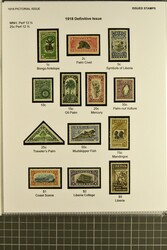
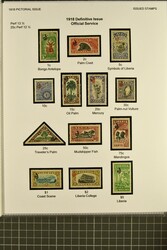
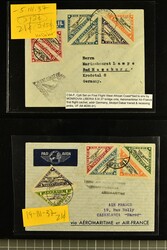
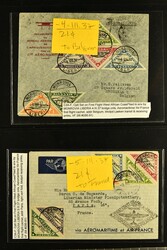
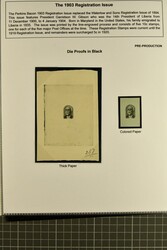
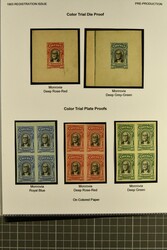
Official Stamps 1909: A substantial and highly specialised
exhibition-style holding of the Liberia 1909 Pictorial Issue with
Official
Official Stamps 1909: A substantial and highly specialised
exhibition-style holding of the Liberia 1909 Pictorial Issue with
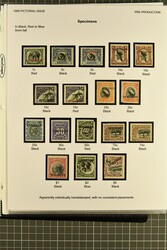
Official Service overprints, comprising an exceptional range of
pre-production material, issued stamps, proofs, varieties, and
multiples, with particular emphasis on the 10 c. "Commerce with
Caduceus" triangular issue. The collection opens with an important
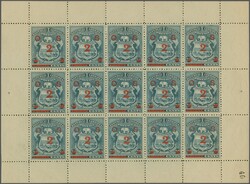
group of “OS” overprint studies and proofs, including practice
sheets for alignment, a striking vignette block of 16 showing
misaligned overprints, and multiple trial impressions in red and
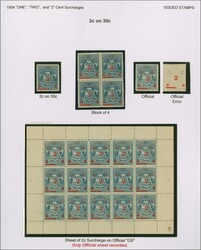
black. Also included are quadruple “OS” overprints on 1 c. plate
proofs (no gum) and additional trial pieces illustrating the
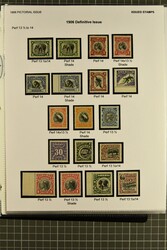
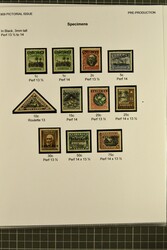
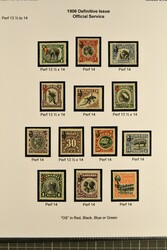
experimental nature of the overprinting process. The issued
Official Service stamps are represented across values from 1c to
75c, showing different overprint colours (red, black and blue) and
perforation varieties (perf. 13½, 14 & combinations), generally in
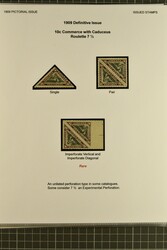
fresh, never hinged condition. A specialised section is devoted to
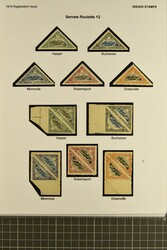
the 10 c. triangular, including roulette 7½ examples with shifted
“OS” overprints (noted as from the same sheet), a rare example
without overprint, and additional pieces illustrating positional
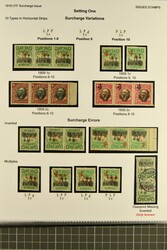
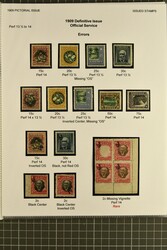
and production characteristics. A strong errors and varieties
section includes inverted “OS” overprints, missing overprints,
colour anomalies (black instead of red), inverted centres, and a
notable 2 c. missing vignette block of four, rare. Further items
include black centre varieties and additional production flaws
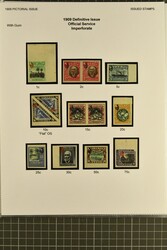
across multiple denominations. The collection continues with a
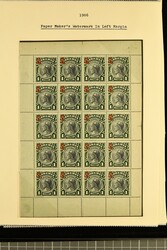
group of imperforate Official Service stamps with gum, comprising
pairs and singles across the key values, including the 10 c.
triangular with "flat" overprint. Of particular importance is the
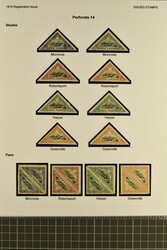
1912 perforate printing of the 10 c. Commerce with Caduceus,
represented by a large block of twelve (perf. 12½), a block of four
(compound perf. 12½ x 14), a further block of four (perf. 14), and
a pair; an impressive and rarely encountered assembly of multiples
from this later printing. Condition is generally fine to very fine
throughout, with many fresh and well-centred examples; some minor
gum or handling irregularities as to be expected in such a
specialised group. A wide-ranging and research-level collection of
this fascinating issue, offering significant depth in overprint
studies, production varieties, and multiples, and providing
outstanding potential for exhibition or further scholarly
development.