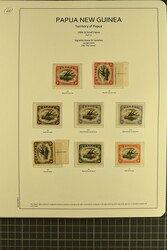
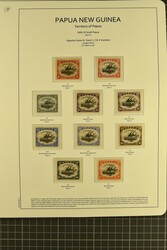
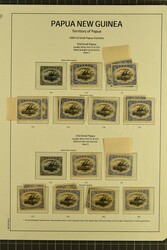
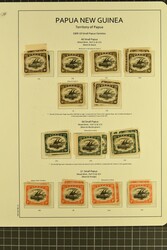
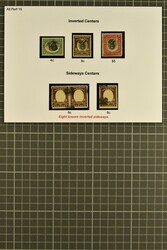
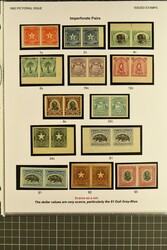
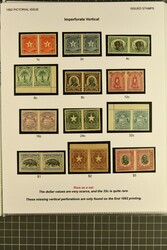
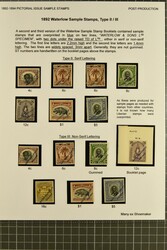
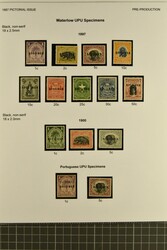
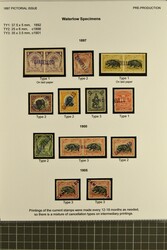
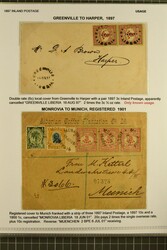
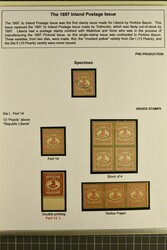
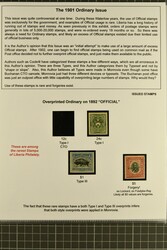
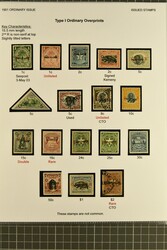
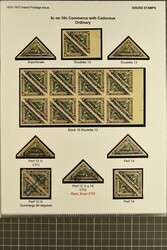
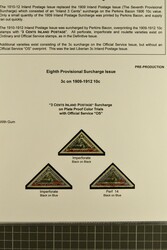
Lots & Collections; Waterlow Archive Specimen Sheets 1892-1905: An
exceptional and highly specialised archival holding comprising
Lots & Collections; Waterlow Archive Specimen Sheets 1892-1905: An
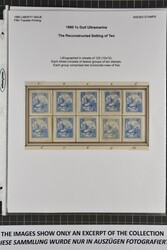
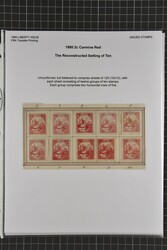
exceptional and highly specialised archival holding comprising two
substantial ring-binder volumes containing the surviving Liberia
Waterlow & Sons archive sheets for the 1892-1905 issues including
Officials (O15/O42), as recorded and analysed in Cockrill, Booklet
No. 25, Appendix C(A). The material represents a rare
reconstruction of the printer’s retained records, preserved in
complete sheets and arranged for study and reference. The
collection includes a wide range of complete sheets from the 1892
issue through the later 1896-1905 printings, encompassing values
from 1 cent to high denominations, with numerous colour variations,
perforation differences, and printings corresponding to documented
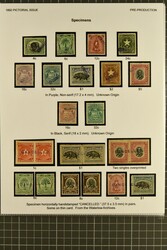
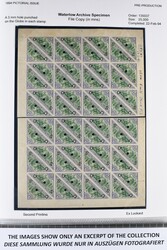
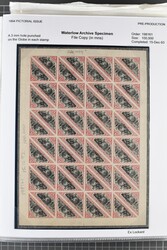
order numbers and production dates. Many sheets bear the
characteristic manuscript "FILE COPY" annotations in the margins,
together with the distinctive punched holes applied by Waterlow for
archival control, in accordance with the classifications described
in the Cockrill study. The group is particularly notable for its
inclusion of both standard archive sheets and the more specialised
categories, including examples with single central punch holes and
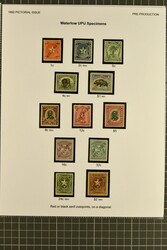
others with paired holes, as well as material relating to the
"CANCELLED" and "SPECIMEN" archive treatments. The arrangement
closely follows the recorded structure of the archive holdings,
with evidence of original order sequencing, printing quantities,
and perforation inconsistencies, all of which are key to the
reconstruction of Liberia’s late nineteenth-century stamp
production. Condition varies, as is typical for archive material,
with some sheets showing effects of water exposure, interleaving
adherence, or minor separation faults, consistent with the known
history of the Waterlow archives during wartime damage.
Nevertheless, the majority retain full margins, original
annotations, and strong visual integrity, making them highly
valuable for both research and exhibition. Housed in two
well-filled binders, this is an important and rarely encountered
assembly of Liberia archival material, offering direct insight into
the production methods of Waterlow & Sons and forming a cornerstone
reference group for the serious student of Liberian philately. Ref:
Liberia, Vol. II, Booklet 25, Appendix C(A), by Philip Cockrill.