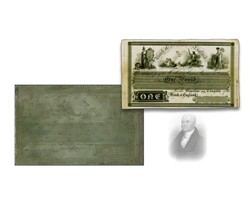
1819: The original "soft" Steel printing plate (123 x 12 x 197 mm.)
for a proposed £1 banknote and a banknote printed from the
1819: The original "soft" Steel printing plate (123 x 12 x 197 mm.)
for a proposed £1 banknote and a banknote printed from the original
plate, offered here and showing the extraordinary "engine turning".
Between 1808 and 1810 Jacob Perkins (1766-1849) and Gideon Fairman
produced the first known books in the United States to use steel
plates. Perkins used "soft steel" plates to engrave on
("siderography") and a method to harden the plates prior to
printing. The Bank of England had offered a prize of £ 20'000 to
anyone who could produce Banknotes that were, in essence, unable to
be forged. After communicating with Charles Heath (1785-1848),
Perkins set sail for England in 1819 and arrived in Liverpool where
he also met with Sir Joseph Banks. From 1819 Charles Heath and his
half-brother George Heath were in partnership with Perkins, working
with the new technique of siderography. Charles Heath replaced Asa
Spencer, a partner of Perkins who returned to the United States,
whilst George Heath became a financial backer. Perkins and his
other American partner Gideon Fairman were in the United Kingdom
for a period, the company trading as Perkins, Fairman, and Heath.
Whilst in 1820 the Bank of England chose another method, other
business for the partnership became increasingly successful and
Perkins's son-in-law Joshua Butters Bacon (1790-1863) bought out
the Heath interest in the company by mid-1829, whereafter they
became Perkins, Bacon. This bank note is an essay for Bank of
England engraved in the USA. The plate still exists as it was never
an issued banknote but an attempt to win the 1820 Bank of England
contract. It is an example of the unique hardened steel plate which
was unique to Perkins and was his invention, showing rows of
"engine turning" which would at this date have defeated any
attempt, even by other printer's, at forgery. Perkins, Bacon would
of course go on to produce the 1840 1 d. black and 2 d. blue. Note:
Sir Joseph Banks, 1st Baronet (1743-1820) was an English
naturalist, botanist, and patron of the natural sciences, who
sailed as a botanist on Captain Cook's first voyage on the HMS
Endeavour, and amongst myriad other achievements is renowned as the
instigator of British setttlement in New South Wales.